
Introduction
Anticipating demographic transition in Europe
A guidebook to support the creation of innovative elderly care cooperatives
Why cooperating?
6 steps for setting up an elderly care cooperative
1.Identifying needs
2.Getting your cooperative together
3.Planning the business
4.Mobilising partners
5.Setting up the structure
6. Launching the business
Bibliography
Elderly care providers regroup different kinds of organisations: public services, non-profit organisations, businesses, etc. They often operate side by side on a same territory, complementing or competing within each other, sometimes even not interacting. Each model has its strengths and limits. An elderly care enterprise may be more independent than a non-profit organisation as they are less dependent on subsidies and donations; this allows its owners to create and organise the services provided according to their own concerns and values. On the other hand, a non-profit organisation may participate to create solidarity among the community, and develop its services (even non-profitable ones) according to the needs of its beneficiaries. Various models aim at conciliating economic viability and social benefits – one of those is the cooperative enterprise.
As we will see later, many different kinds of cooperatives exist. However, they all share common principles and characteristics, making them a model worth considering to improve the elderly care services on one territory. The International Cooperative Alliance describes cooperatives as “an autonomous association of persons united voluntarily to meet their common economic, social and cultural needs and aspirations, through a jointly owned and democratically controlled enterprise” (International Co-operative Alliance, sd). It can be summarised in the following way:
Cooperative = People gather to meet common needs through a democratic business
The basis of a cooperative is one group of people, gathered around a common project or idea. This group collectively owns and takes part in the management and decision-making processes, but also shares the risks and responsibilities. In accordance with the principle “one member = one vote”, each member has an equal stake and opportunity to contribute to the cooperative management.
Gathering people around a common project may also make the cooperative more inclusive than other businesses, for instance by allowing people who have limited access to resources to be admitted as members and be fully involved in the organisation to share their experience, knowledge and creativity. As businesses, cooperatives make profits: those are, at last partly, reinvested in the organisation itself. Once again, the way investments will be made, and the goals to be pursued are decided collectively by the members.
Finally, the primary objective of the cooperative should not be to generate profit for its members, but to meet its members’ needs – and, very often, the needs of the community as a whole. Depending on the founding group, these needs can be diverse: broaden employment opportunities for caregivers, provide new or cheaper elderly care services, or allow care receivers to be actively involved in the management of their services for instance. Since cooperatives are owned by their members who are themselves part of a community (care receivers’ relatives, workers, etc.) and address the needs of this community, cooperatives contribute to the general interest of the community.
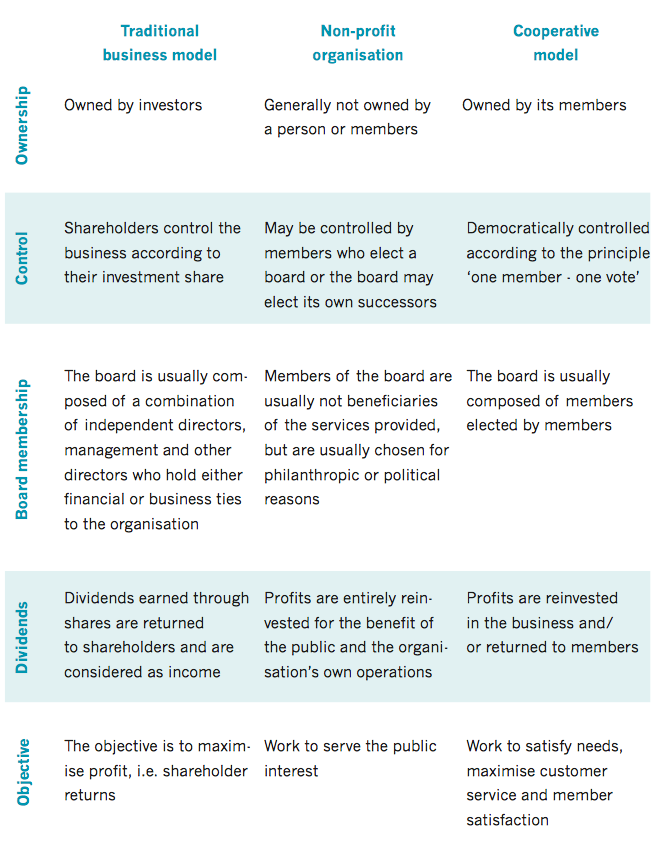
Image Reference: (Aliberti, et al., 2014)